Journal

How to Make a Lookbook. If It's Really a Catalogue, Don't Shoot It Yet

How to Make a Lookbook. If It's Really a Catalogue, Don't Shoot It Yet

Open the lookbook on your desk and cover every price and product code with your fingers. If you still want to turn the page, you are holding a lookbook. If you stop, you are holding a catalogue with a lot of photographs. Making a lookbook begins with telling those two apart.

A catalogue is for people who came looking for clothes. A lookbook is for people who weren't looking yet, and it hands them a reason to start. Shoot the same garments in the same studio, blur those two purposes, and the book does neither job.

Front, side, back. Full length, waist up, a close crop of the collar. Thirty careful frames, every one of them accurate, every one of them the same temperature. Somewhere around the third, the reader realises these are photographs for checking, and closes the book.

What a Lookbook Is: The Difference Is What the Reader Takes Home

A lookbook is a photographic book that shows a season or collection together with the way it is worn and the world it belongs to. That covers the definition. What the people making one need to know is not the definition but what is left in the reader's hands when the last page turns.

Someone who closes a catalogue takes home a product code and a price. Someone who closes a lookbook takes home a single picture of themselves, wearing that coat, in that kind of place.

So a lookbook can carry less information than a catalogue. No fibre content, no full size run. What it needs is for the photographs to say, before any words do, whose clothes these are and what hour of their day they belong to.

A catalogue explains the clothes.
A lookbook decides where they live.
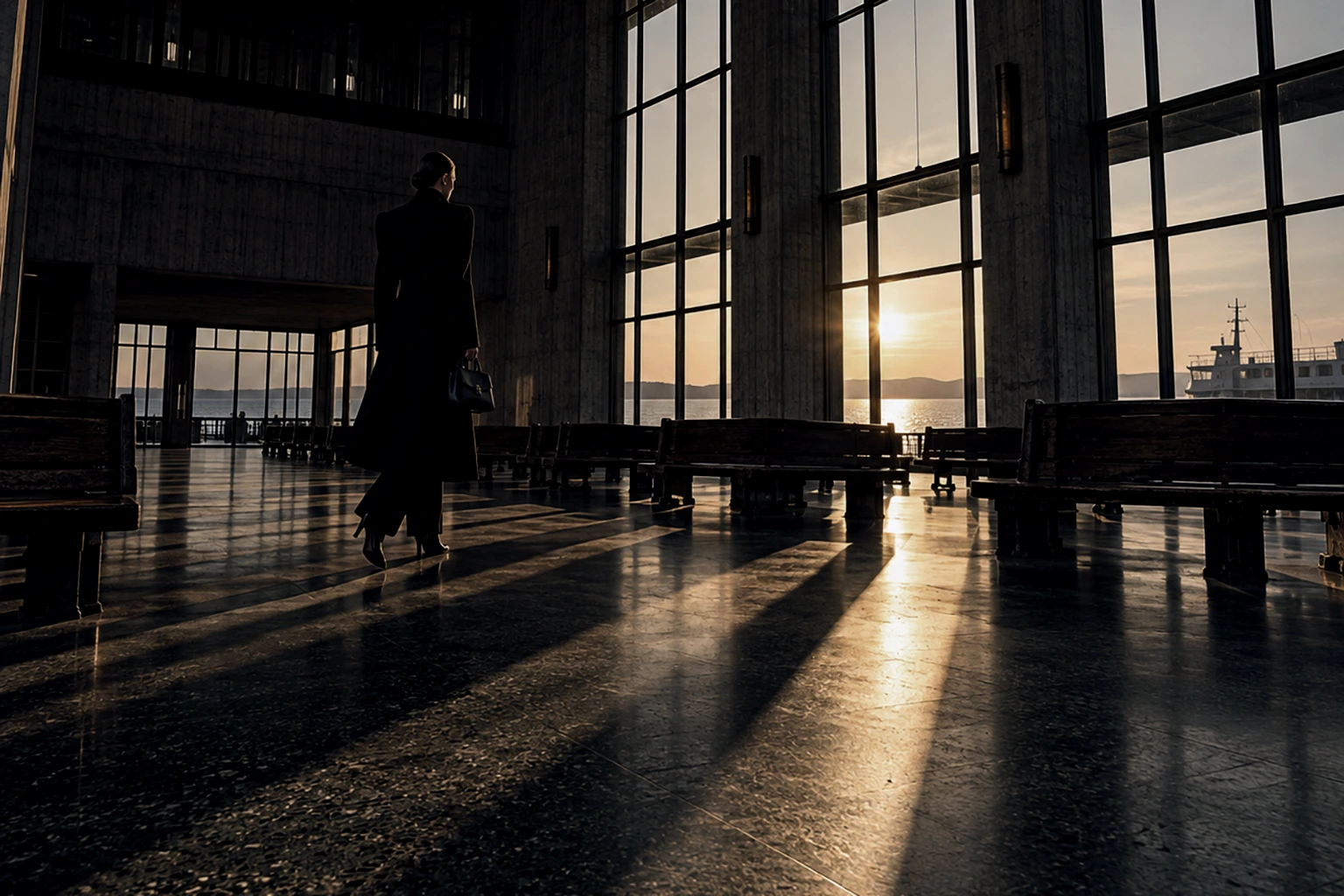
A lookbook wide shot: a woman in a long black double-breasted coat crosses a ferry-terminal waiting hall striped with low sunset light

Before the Lookbook Shoot: Decide Who, Where, and What Time

Three things come before the clothes on a lookbook shoot. Who is wearing them. Where they are. What time of day it is.

Who is not the model's face. It is that person's life. What they drink in the morning, which station they get off at. Decide that far and the rest follows on its own: how finished the hair should be, how worn-in the shoes.

Where is not a background colour. It is a place that person would choose to walk into. There is nothing wrong with a white studio wall. It's only that a place belonging to no one makes clothes look as if they belong to no one.

What time is the one most often missed. The slanting light of ten in the morning and the low light just before sunset turn the same black coat into two different garments. Hold one hour of the day across the whole book, and the world of it becomes a single line. The practical steps for matching light, background and distance are in our piece on photo consistency.

Write those three on one sheet of paper, then make the shot list. Don't run the product codes down the page. Run actions down it instead: open the door, take off the gloves on the bench, look back over the shoulder. Then assign the clothes to the actions. On the day, the set moves on "what do we ask them to do next" rather than "what do we shoot next", and the shoot itself gets shorter.

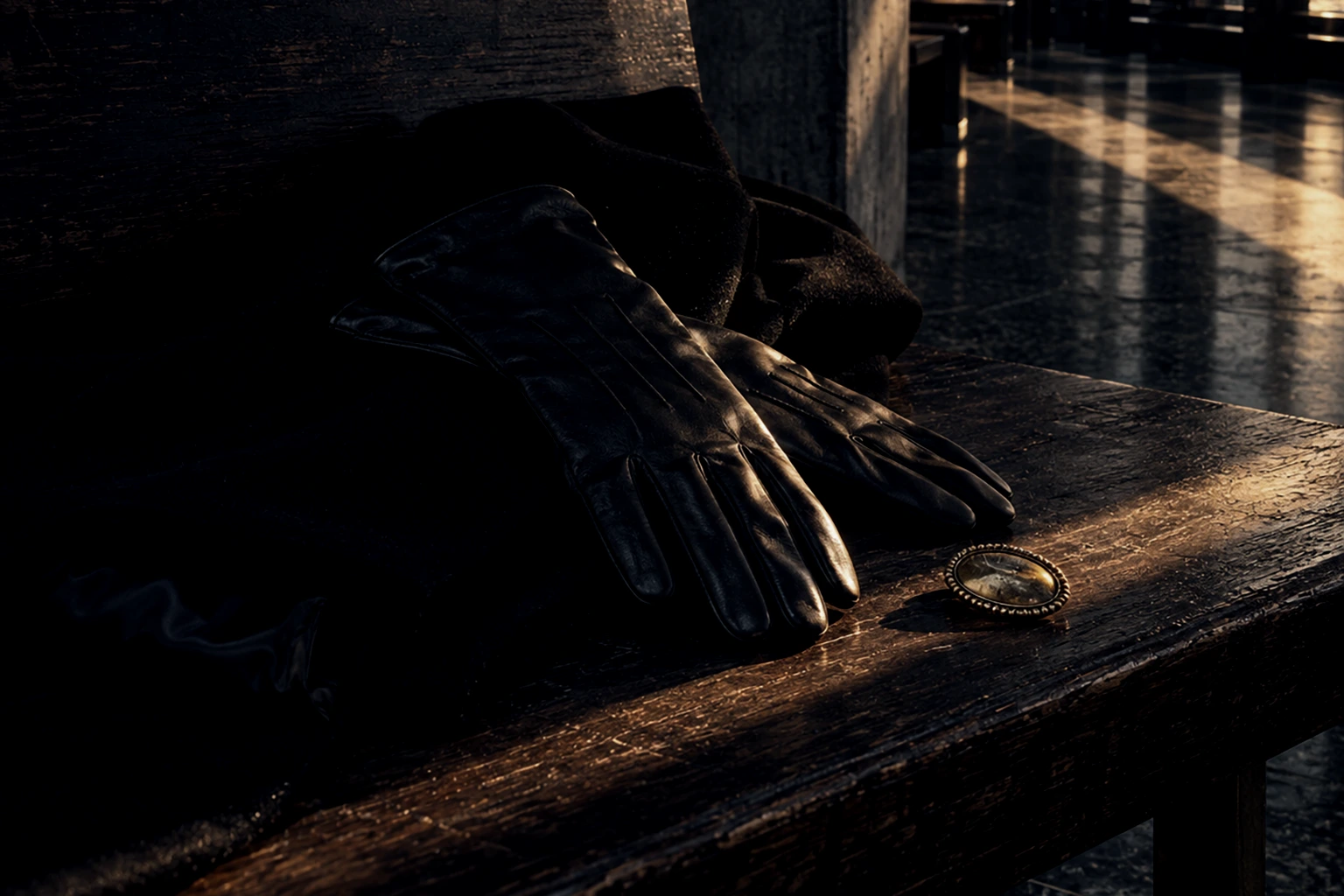
A still life with no garment worn: a folded black wool coat, leather gloves and a dusty-gold brooch on a waiting-room bench in one stripe of sun

Lookbook Layout: Build It on Breath, Not on the Number of Looks

Twelve looks, twelve pages. Lay a book out that way and it becomes a march at even intervals. The reader is made to walk at one pace and never learns where to stop.

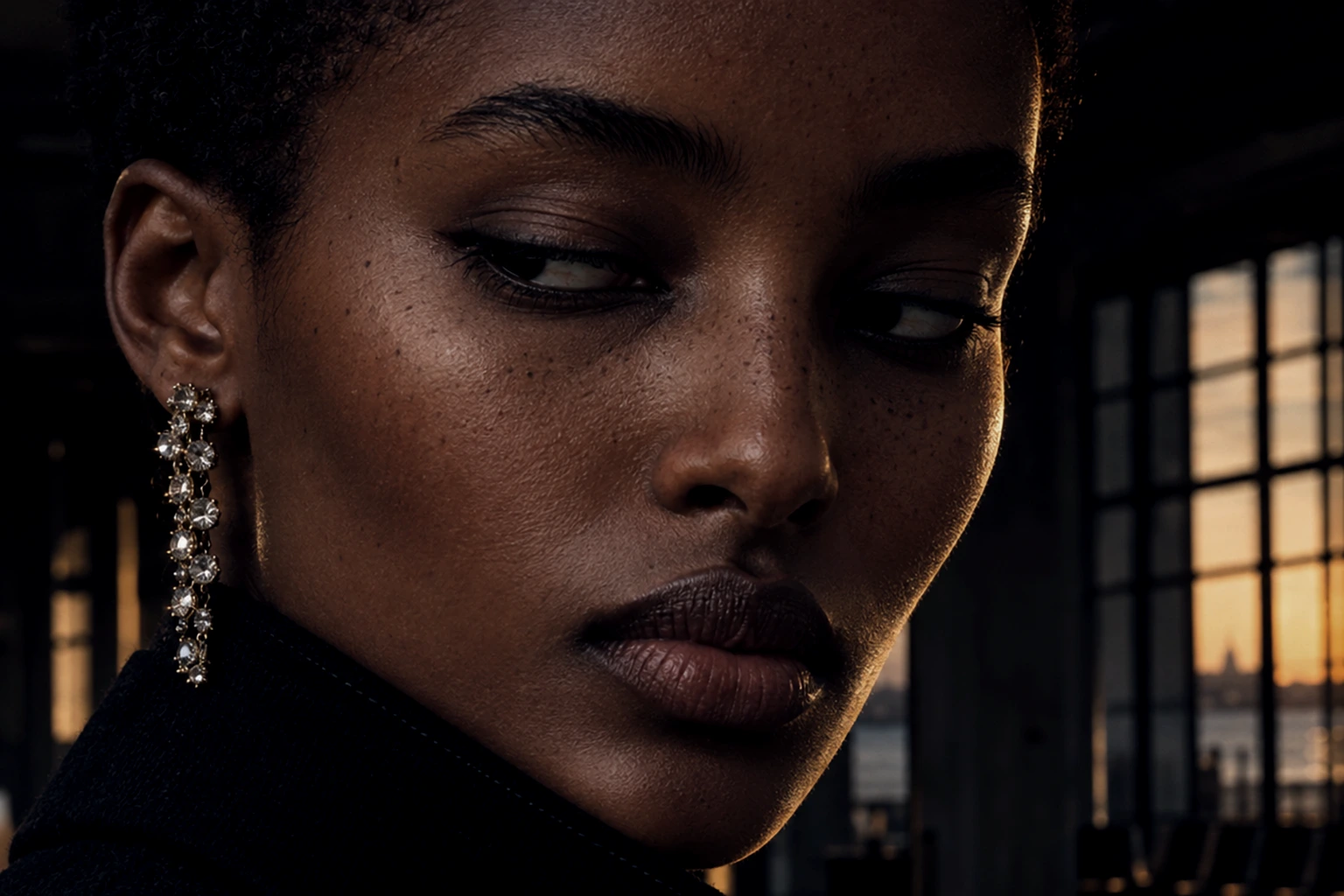
Build the sequence on breath instead. Open the first spread with no clothes at all, only the place and the light. Then one wide, full-length frame. Then something close: a cuff, a hand. A face in close-up once or twice in the whole book. A still life with no garment, to let the reader inhale. Then back out to the wide.

That cycle of wide, close and space becomes the rhythm of the finger turning pages. Not every garment needs the same size on the page. Three hero pieces are enough for one book. The rest step back and hold up the world the heroes live in.

You are not cutting the number of clothes. You are deciding where the weight falls. With three heroes, a book of around sixteen pages has more than enough room to breathe.

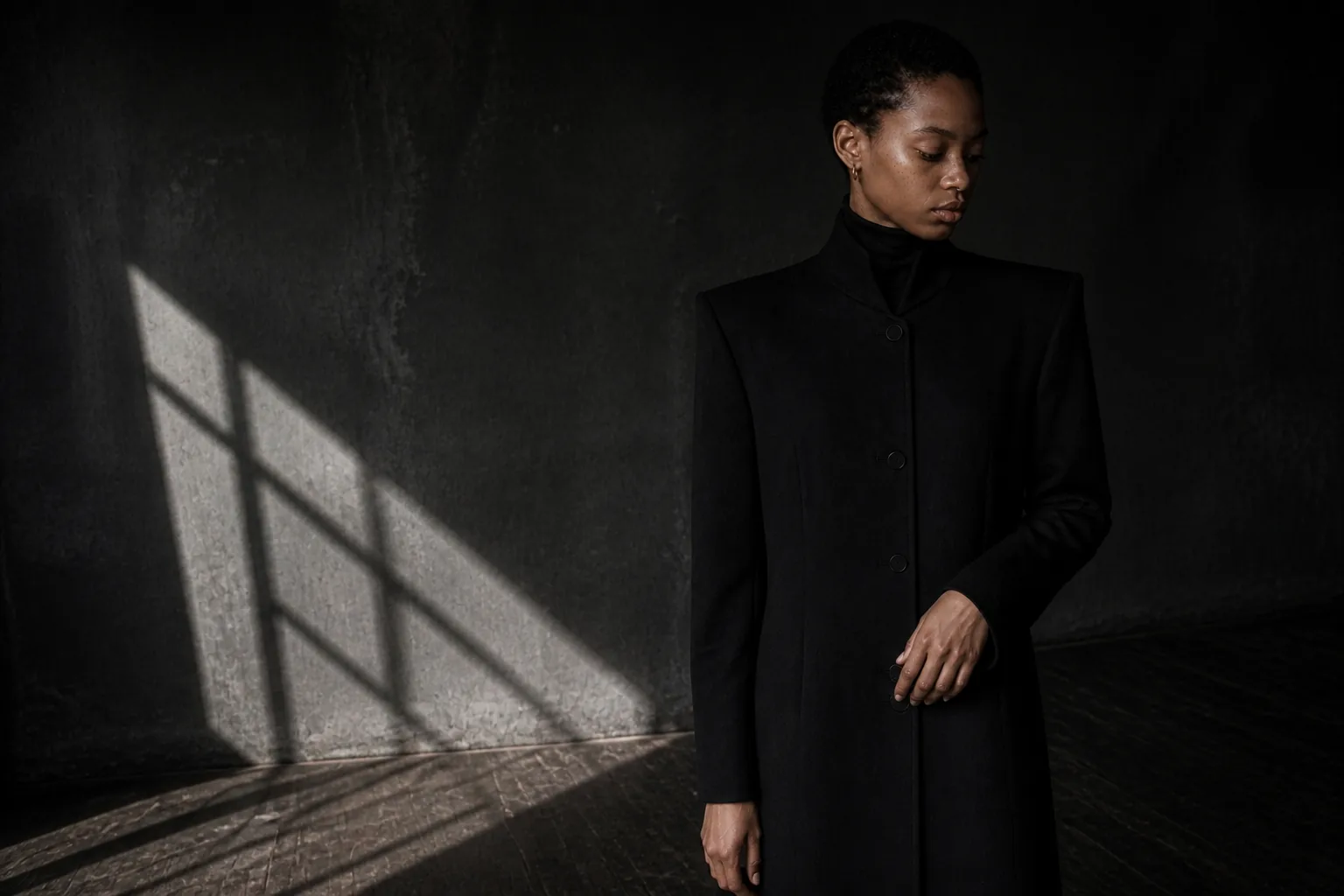
A close crop of a woman turning back over her shoulder in a high black collar, a long diamond earring catching one glint of sunset

Why Lookbook Photography Shouldn't Shoot Clothes Head-On

Facing the camera, standing straight, full length. It is the frame in which clothes are recorded most accurately. It is also the frame a lookbook is least remembered for.

People are drawn to clothes not while the clothes are still but just after they have moved. The swing of a coat hem on the first step. The fold that gathers at the shoulder when someone looks back. The way cloth sinks as a hand goes into a pocket. What is good about a garment shows up in the part that follows the body a moment late.

So on set, decide the action rather than the pose. Not "stand there", but "open this door and walk out". One instant from the middle of that says more than ten frontal shots.

Clothes are most beautiful a moment after the person wearing them has moved on.
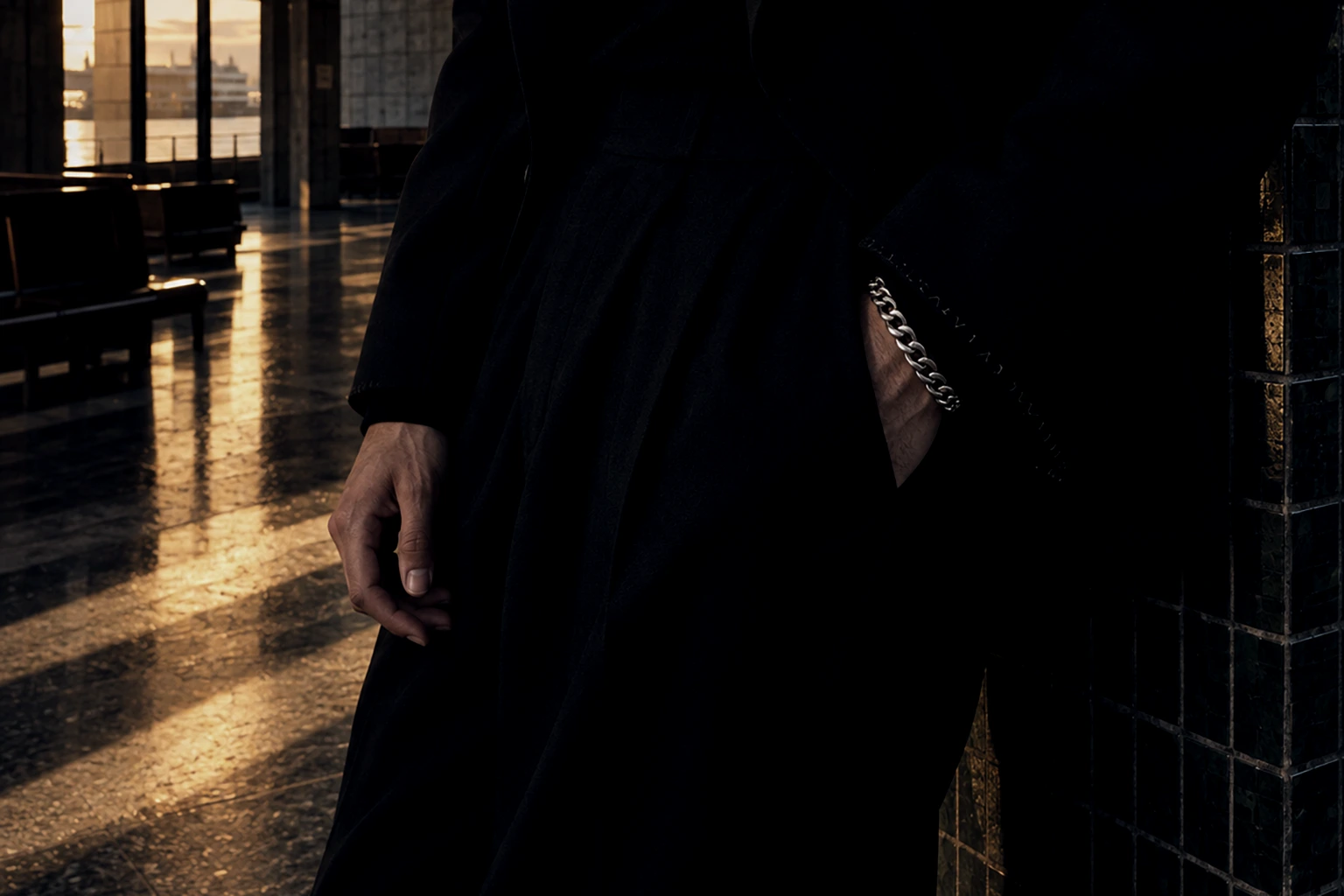
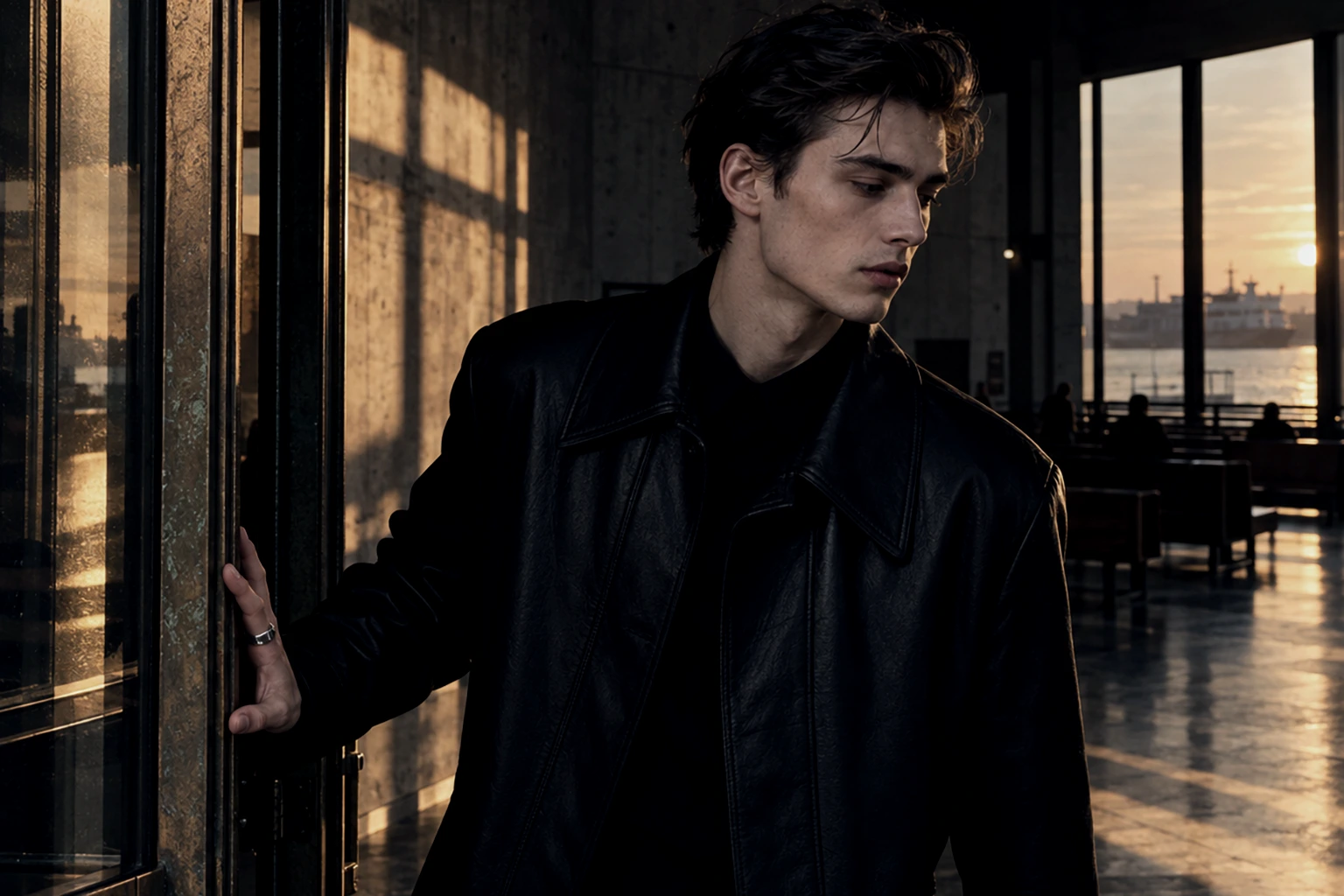
In a men's lookbook, a hand sliding into the pocket of black wide trousers, the cloth sinking, shoulder resting on a tiled pillar

A Men's Lookbook Speaks Through Posture, Not Expression

Men's lookbooks tend to flatten because they try to show range through the face. Smiling, not smiling. Between those two, the same face is repeating itself before page ten.

Menswear shows in posture before it shows in the face. The angle of a shoulder resting on a wall, arms left uncrossed, how wide the knees fall when he sits. Where the weight sits tells you whether he is in a hurry, waiting, or already on his way home.

Hold the expression down through the whole book. The less the face says, the more the reader tries to read the person from the clothes and the stance. That effort of reading is what turns a lookbook from something seen into something read.

Choose accessories as tools that help the posture. A hand wearing a signet ring, resting on the edge of a door. A hand going into a pocket at the angle that shows a chain bracelet. The accessory is on screen for an instant, yet that instant answers the question of where the hand goes, which is a question of posture.

A Fashion Lookbook Changes Shape With the Person It's Handed To

The same season's lookbook takes a different correct form depending on whose hands it lands in.

For buyers and stockists, add a separate sheet of codes and prices. Keep the numbers out of the photographs and move what the meeting needs to the back. That protects the world of the book and the business at once.

For a website or social feed, assume every frame will be read on its own, cut loose from the rest. Whichever image someone meets first, it should be clear they are in the same hour, the same light. Without the order of a printed book to lean on, the agreement of time across every frame does the work of a name tag for the brand.

For trade shows and sales meetings, have both a printed book and a PDF ready. The print stays on the buyer's desk; the PDF gets passed around inside their company. End both in the same order, on the same last frame. The format changes, and the picture the reader takes home stays one.

Making a Lookbook Starts From the Last Frame

What a book leaves behind is set not by the cover but by the final page. The frame seen just before closing is the one carried home as the memory of the brand.

So choose the last frame before the shoot. A back walking away, a room with everyone gone, nothing but light through a window. Once the ending is fixed, the order leading to it is fixed, and once the order is fixed, so is the number of frames worth shooting. Hunt for the last frame after the shoot instead, and every picture weighs the same; you end up laying them out one look per page after all.

If making a lookbook had to fit in one line, it would be this: before you line up the clothes, decide what the reader will take home. Until that is decided, don't shoot yet. Once it is, you'll find there is surprisingly little left to shoot.
Read next
How to Make Your Photos Look Consistent: Stop Matching, Start Discarding
What a Website Photo Shoot Actually Costs — and Why It Is Not About the Number of Shots
All Articles
Lookbook

We'll Start From the Last Frame, Together

Who, where, and what hour. We help you settle those three before the shoot, then build the lookbook's sequence and images with you. Tell us about your brand — we usually reply within 2–3 business days.

Start the Conversation