
Journal

Company Profile Design. The Longer You Work on the Cover, the Less Gets Decided Inside

Company Profile Design. The Longer You Work on the Cover, the Less Gets Decided Inside

The first decision in company profile design is not the image on the cover. It is how many pages the booklet will run to, and in what order those pages will be read. Material that refused to settle after weeks of collecting other people's brochures tends to settle the moment those two are fixed.

A company profile begun at the cover almost always stalls. The cover is a summary of the contents, and there is nothing to summarise while the contents are still undecided.

What emerges after weeks of that stall is a layout everyone has seen before. Unable to decide, we borrow something already decided. Nearly every company profile that looks like every other one was built in this order.

How Many Pages a Company Profile Brochure Actually Needs

If the structure of the brochure will not settle, fix the page count first.

Printing works in multiples of four. Eight pages, twelve, sixteen. Choosing one of the three before anything else sorts the material into what goes in and what does not. Gather content without a frame around it and every piece you gather will look necessary.

For most companies the honest answer is eight. Cover, a word from the founder, two or three lines of business, selected work, the company details, back cover. That fills it. Twelve or more is warranted only when the business runs on several distinct pillars, each needing its own explanation.

Once the page count is set, the order follows. Order it not by what the reader wants to know but by the order in which the reader becomes able to believe you. What the company does first, why it can do it second, who does it last. Reversed, you are asking a stranger to read an introduction before they have any reason to care.

Count in spreads, not in pages. What a reader takes in at once is always two facing pages. Decide early that one side carries the image and the other the text, and the structure survives whatever gets added later. A booklet designed page by page reveals its mismatched spreads only once it comes off the press.
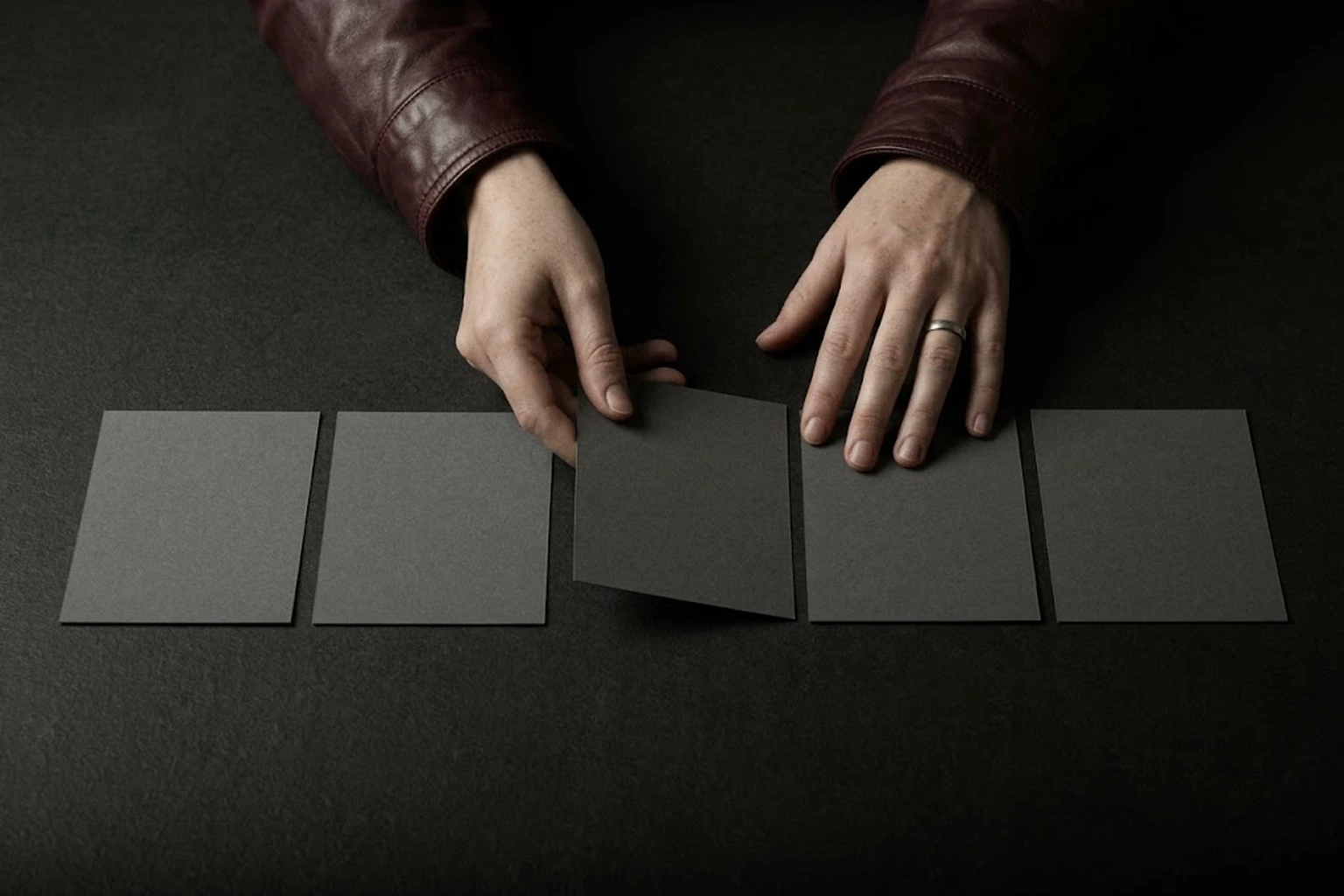

Two hands arranging black cards

A Beautiful Company Profile That Sits Unread

Requests that begin with the words "we want something elegant" tend to miss, if they are built exactly as stated.

Unlike a screen, a printed booklet has a fixed way of being received. It is handed over, put in a bag, set down on a desk, and opened again some days later. What can be read on that second opening is what the profile is worth. Not whether it looked beautiful the first time.

Booklets that get a second reading have one thing in common: any page you land on makes sense by itself. One subject per spread, legible without remembering the page before. Build something that only works read straight through, and there is no second opening.

A company profile is not a book that gets read end to end.
It is paper on which one page gets read.

Stripping out ornament is not about refinement. It is so that on the second opening, the thing being looked for is found quickly.

A man with folded arms against black

The Cost of Company Profile Design Is Set by Scope, Not by Drawing

Quotes for company profile design differ by several times between studios, and the difference is not skill. It is what the number includes.

There are stages. Laying out text and photographs you supply. Deciding the structure together. Interviewing and writing the copy. Shooting the photographs as well. Between the first stage and the last the workload differs several times over, and so does the figure. When you compare quotes, compare the stage, not the number.

The other thing that moves the figure is not page count but the number of distinct layouts. Eight pages with eight different arrangements needs eight designs; eight pages where the business section repeats one pattern needs three. Adding formats costs more than adding pages.

Paper and finishing move the figure too, but those can be settled last. The same layout printed on a heavier uncoated stock reads differently on its own. Finishing such as foil or a die cut works the other way: over a weak layout it only makes the weakness louder. Finishing makes a good thing better; it will not decide anything that has not been decided.

Keep print costs in a separate column. Design is paid once; printing is paid every run. Two hundred copies now and a revision a year later usually costs less than a thousand copies at the start — something in a company profile always goes out of date within the year.

A woman's profile before a concrete wall

The Cover Is Decided Last

What goes on the cover is considered only once everything inside is settled.

The cover has exactly one job: to get the booklet picked up a second time from a desk where it has been lying. That does not require information. The company name, and one line making clear what the company does. If those two read, the cover works.

The temptation is to list the lines of business on the front, and the more that is listed, the less is read. A cover crowded with text becomes a grey field from a few steps away. A cover is seen at arm's length. Judge it on your desk and you will always put too much on it.

If you use a photograph, use one. Covers built from several photographs blur which part of the business is the main one — which, read as a signal, is the most dangerous thing a cover can do.

A company profile that begins explaining on its cover does not get read inside.
The explanation is inside. What belongs on the cover is a reason to open it.
A stack of white paper on a desk by a window

How to Make a Company Profile: It Comes Down to the Order You Gather Things

Where the making of a company profile stalls is almost always in gathering the material.

Gather the numbers and facts before the photographs. Year founded, locations, headcount, the sectors your clients work in, the shape of representative projects. None of it moves under interpretation, so fixing it early is never wasted. Text and photographs are gathered after that frame is standing. Reversed, the writing ends up serving whichever photographs turned up, and what you meant to say arrives last.

Split the photographs early into what must be shot and what can be used as it is. Attempting to reshoot everything stops the project for weeks. In practice what genuinely needs reshooting is one portrait of the founder and one image that stands for the work.

And do not write the whole manuscript in one go. Write a single spread, then check that it physically fits. The area of a page is fixed. Learning how much goes in before you write is faster than cutting after.

Proof on paper, not on screen. Print at actual size, put it on a desk, and the crowded margins and the underexposed photographs announce themselves immediately. A company profile is read on paper, so it passes or fails on paper.

Work Backwards From the Moment It Is Handed Over

Before anything is designed, decide the one situation in which this booklet is handed over.

Passed to someone standing at a trade fair; opened on the table during a meeting; arriving by post before you do. Those three want entirely different objects. Standing, it must be thin and light. Opened while you talk, it needs order. Arriving alone, it must read without you.

Try to serve all three and you get something that serves none. Choose one, and cover the rest with separate pieces of paper. A single leaflet, the profile itself, a short note that fits an envelope. Dividing the roles usually costs less in the end.

Company profile design begins once that much is settled. The order, the page count, the moment of handing over. With those three fixed, the rest is quiet composition. Without them, however beautifully it is set, the setting is only making indecision look beautiful.

Read next
Branding Costs for Independent Businesses: Decide the Scope Before the Budget
Brand Website Production: Five Stages That Align Atmosphere and Results
All Articles
Company Profile

We begin with the order of the pages

If cover ideas keep piling up while the contents stay undecided, we take it from the order. Tell us about your brand — we usually reply within 2–3 business days.

Start the Conversation